Environmental groups mobilization and protests: More than meets the eye
Ever wonder what drives environmental non-governmental organizations (ENGOs) to undertake campaigns to protect the oceans, protest forests’ clear-cutting and fight to have bis-phenol A banned from all plastic bottles? This is one of the questions that has driven another side research project I have conducted throughout the past decade.
I’ve always been puzzled as to why would numerous individuals of different backgrounds decide to come together and volunteer their time to engage in environmental activism. Putting pressure on government is an activity that has taken place for a long time, and with the recent increase in media exposure to problems such as climate change and pollution, we have witnessed a spiraling growth of ENGO mobilizations.
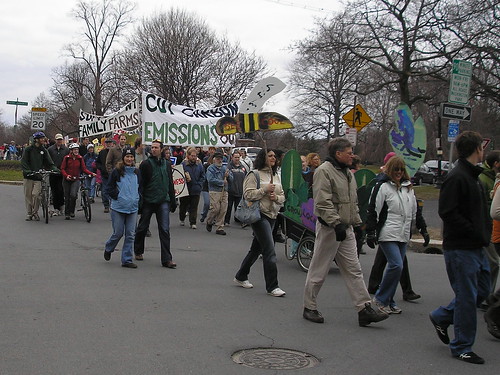
Global warming protest outside Washington Park (Photo: Pembleton/Flickr)
You may or may not know that one of the most famous environmental groups (Greenpeace International) was initially founded in 1971 here in Vancouver.
In 1971, motivated by their vision of a green and peaceful world, a small team of activists set sail from Vancouver, Canada, in an old fishing boat. These activists, the founders of Greenpeace, believed a few individuals could make a difference.
Their mission was to “bear witness” to US underground nuclear testing at Amchitka, a tiny island off the West Coast of Alaska, which is one of the world’s most earthquake-prone regions.[Greenpeace website]
My research on ENGOs has focused less on understanding the motivations behind environmental groups’ (a topic that, while interesting, provides in my opinion less insight on potential public policy options) and more on the strategies that ENGOs use to put pressure both on industrial polluters and on governments at different scales (local, regional, transnational).
Moreover, I have been interested in gathering empirical evidence of the formation of transnational coalitions of ENGOs and how these coalitions use their collective knowledge to engage in strategic behavior and put pressure on national governments. Interestingly enough, there are many cases where ENGOs have been successful in pressuring polluters and shaming governments.
However, one of the most interesting insights that I have found in my research is that, for an issue to really galvanize public opinion, it has to be notorious and affect the population in a deep way (that is, it must be scary enough to make people put words into action). As I mentioned in my previous post on the governance of wastewater, it irks me to know that other pressing problems, such as dwindling supplies of water and increasing wasteful behavior on the part of urban populations are being overlooked in favor of climate change.
While it appears as though environment (and climate change) are two of the issues that Canadians indicate as public policy priorities, I am still surprised that there are not more environmental group protests on issues of pollution, and still place so much emphasis on climatic change issues.

My hope is that, in the coming years, people will continue to mobilize and try to change how environmental policy is shaped and implemented, but hopefully by then, we’ll have a much more holistic view and not only one shaped by excessive press coverage of environmental issues that, while pressing, are not the only ones we need to look at.


Interesting. Is your research going to be published somewhere? Or are you gonna post it? Would like to read it since I do a lot about environmental stuff and study international development.
http://www.globalina.wordpress.com
@ globalina – Yes, I’ve published a lot, if you want contact me via e-mail (hummingbird604 at Gmail.com) and I’ll send you some of my research papers. This is my personal blog, but I’ve started to add more posts about what I study as a scholar.
I’d also like to see this research. Do you think that protest works beyond simply raising awareness of an issue?
[…] my research-related posts, I have previously talked about my research on wastewater governance, on environmental NGO mobilization, and now I’ll briefly talk about what I have studied on water supply […]
[…] Environmental non-governmental organizations (ENGOs) take it upon themselves to participate in vario…. Human rights organizations often seek to galvanize public opinion and protect disadvantaged people. This the basis for a healthy, participatory society. […]
[…] my research, I’ve written about how ENGOs use various types of strategies to galvanize public opinion (often, through mobilizations). This time, the work that these […]