This is a guest review of the movie Generation Rx by Christopher Trottier – thanks for the review, Christopher!
Unmasking the Negatives of Psychiatric Drugs
A Review of Generation RX.
Generation RX is less a documentary and more an editorial. As long as you do not expect a passionless dissertation of the psychiatric pharmaceutical industry, the movie works. Where Generation RX succeeds is in exposing the other side of drugs like Ritalin and Prozac — and the effects they have on children. Is psychiatric medication the magic cure-all for any and all problems?
As it turns out, it is not. Generation RX spits out fact after fact showing how psychiatric medication can go wrong. Prozac use in children increased the odds of suicidality by 50%. Ritalin may cause a crytogenic effect in children suffering from ADHD. Zyprexa has been linked to obesity. These statistics come at such a dizzying rate, it was tough to wrap my head around all them.
But then, Generation RX exposes the human side. During a 1991 public inquiry, one lady testified she was diagnosed Prozac for weigh loss. “You can never be too rich or too thin,” her doctor said. A few days later, she had suicidal thoughts for the first time in her life. That’s when it hits you: beyond the statistics, real people feel negative side effects in real ways.
So what must be done about all this? There needs to be a firewall between the FDA and pharmaceutical companies. Doctors conducting clinical trials should not derive direct financial benefit from a drug’s approval. Dr. Scott Ruben, for instance, allegedly fabricated his study of Effexor XR. How much money did he make when this anti-depressant hit store shelves?
I wish Generation RX spent more time delving into peoples’ individual stories. Christopher Blagbrough’s story is a particular tragic one. Yet we only know (from the movie) he stabbed his father, then later committed suicide while (as his father states) on Prozac. What happened between these two events?
Despite this one criticism, the movie succeeds because it exposes the other side of the story quite well. Many of us know that depression is caused by simply biology. But is that always the case? And our mental ailments always go away by a simple ingestion of a pill? Generation RX makes us consider otherwise.
Admittedly, a good friend had a role in Rigoletto tonight (presented by the Vancouver Opera). But no, having Sheila singing in the performance I attended wasn’t the only I loved the performance. It was, for sure, one of the many reasons. But I also loved the ensemble cast, the re-invention and somewhat avant-garde and risqué approach taken by the director.
A couple of disclaimers. First, I’m the son of a former opera singer (whose voice went from soprano to mezzo). Second, Rigoletto is my brother S’ favorite opera (and one of my Mom’s favorites). Third, I grew up accustomed to listening to arias at home. And fourth, I love “La Donna E Mobile” (which is one of the canzones of Giusseppe Verdi’s opera in three acts Rigoletto).
Manyofmyfriends attended the Vancouver Opera “Bloggers Night” so I can basically let them give you their views and give you a recap of what Rigoletto is all about. However, I figured that I’d offer my own impressions.
Coming from a matriarchal culture (despite the fact that my Dad’s influence on us was definitely important), it is somewhat refreshing to see a patriarchy-focused opera. In Rigoletto, we see the amazing (sometimes overwhelmingly blinding) love that Rigoletto has for his daughter, and the lengths to which he will go to protect her. This opera is also very interesting and distinctive in that it’s homme-fatale-centric. Yes, contrary to Carmen (where the femme fatale is devious, mischievous and deceitful), in Rigoletto, the object of the daughter’s affections is also the demise of Rigoletto. By the way, Tris and I reviewed Carmen for Sexy in VanCity a couple of months ago. You should check our video review.
This performance of Rigoletto was very interesting for me in that it was also a re-invention of the classic tragedy. It combined some elements of nouveau theatre with classic opera. Admittedly, I had a great experience and I wouldn’t have traded going with JT for anything else (sorry I missed the Vancouver Bloggers Opera Night, but tonight was special to me). He was asking me whether all operas are tragedies. Sadly, the genre is pretty dramatic and yes, the vast majority end up in tragedy. Overall, it was a very fun night. I am sure I’ll be doing a bunch more opera performances this year. Kudos to the Vancouver Opera!
Date: Saturday, March 21st, 2009
Time: 7:00PM
Location: Trinity Western University – Northwest Auditorium 7600 Glover Road Langley, BC V2Y 1Y1 Canada
– Screening of FLOW: For the Love of Water
http://cannedcumulus.files.wordpress.com/2009/02/flow-719407.jpg
– Speech by Ken Baerg of Run for Water on his experiences abroad in Ethiopia working on water well projects. Jet Takoaka, Hope International’s Development Officer, will also be speaking.
– Additional speech by Dr. Raul Pacheco (He has 10 years of experience in research on wastewater governance, comparative environmental policy in North America, urban sustainability and environmental NGO mobilizations.)
– Free door prizes
– Opportunities to get involved with the global water crisis through OxFam Canada, TWU, Council of Canadians, Run for Water, Ryan’s Well Foundation and WaterDrop.
For more information please go to: WaterDrop.ca
Or contact us at info@waterdrop.ca
Or give us a call at 778.868.0776
I had to dash out of Third Tuesday (which fell on a Monday due to St. Patrick’s Day) but I had promised Tanya and Nate that I would come by and that I wouldn’t miss it so I stayed for most of Nate Elliott’s talk on The Future of Influence. Tris liveblogged it on the M2O blog, and here are my rough notes.
– The lasting appeal of influential consumers
– Who are the new influentials?
– The changing nature of influence
– What does it mean?
Marketers have always used consumer-to-consumer influence. They find influential people. They get them to pass along the message. Amway follows a similar message. Avon, Tupperware. People trust what other consumers tell them. You find influential people in the community. As a company, you give these influential people an interesting message and then you rely on these influential people to spread around the message.
Traditionally, personal recommendations have carried strongest influence
Axis X (Proactive vs. Reactive recommendations) axis Y (Broadcast vs. Personal recommendations)
Strongest influence – high volume, high trust (e.g. personal request for advice)
Medium influence – highest volume, medium/high trust e.g. Tupperware party, email from a friend
New influentials – are internet users who maintain a weblog or personal homepage, who join in discussions on internet message boards, forums, or chatroooms, or who regularly update their social networking profile page.
Classic influentials – internet users who say they are the first person others come to for recommendations on music, films, tv programmes, books, consumer electronics, and technology
New influentials exert active influence but are rarely sought out.
Classic influentials – primarily exert passive influence by responding to requests for advice
New influentials – primarily exert active influence by proactively giving advice
New influentials and classic influentials sit at opposite ends of spectrum.
While classif influence remains stagnant, new influence continues to grow. 69% of Canadian online users are Spectators, 67% Joiners, 28% are Creators and 27% are Critics.
As users grow overwhelmed by influence, they will look for greater context. In the past the value of new influence was (not enough reviews/trust of consumer advice).
I had an opportunity to be out today with five of my closest friends. These are people I met when I was doing my PhD and with whom I have developed a very, very strong bond. We were discussing the whole ‘civilians/bloggers’ thing and my brother made one point that really struck a chord with me. I am not surprised in the very least that he gets me so well.
Here is the thing – whenever I talk about my offline and my online friends, I use the typology “civilians/bloggers” mostly to provide context, to explain where the connections come from. Sadly, many a time this characterization of my friends has led some people to indicate to me that differentiating friends this way creates more of a chasm than I actually have ever intended to.
Truth be told, I have never intended to create a division between my online and my offline friends. There is no reason for the chasm, and frankly, I’d like people to realize that it’s not my intention. That’s all.
I had never reviewed The End Cafe for dinner (although I had already had a burger there once, and I had written about it before on my blog). But for last Vancouver Bloggers Meetup, I hadn’t had any food all day and was incredibly hungry so I decided it was time to have dinner there again.
I should preface this review by saying that I have had food at The End Cafe before (a burger with fries) but this time, it tasted like glory. Moreover, I had the pleasure of having dinner with Isabella and Laura, who arrived early to the meetup. I ordered yam fries with garlic mayo to share with Isabella and a club sandwich for myself.
The club sandwich was rather large (which is good, because in this economy, restaurants really need to give you value for your money. It came accompanied with a salad of fairly decent size (given that I was already munching on yam fries, I didn’t mind the salad, hehe). I would definitely recommend The End Cafe for dinner, although as mentioned before, it does have music in the background. If you’re not used to the feel of sports bar, you’ll need to get used to it.
On several positive accounts: the staff is super ultra friendly and they really try their very hardest. The owners are very open to constructive criticisms and suggestions. They were extremely accomodating to me as the organizer of the VBM. In regards to the space, it’s a large venue and I would hold the VBM here again (maybe not every month, but definitely will repeat as there has been a very positive response from many people. We’ll have to see how we deal with noise at some point. But this sounds more like a review of the VBM rather than a review of The End Cafe. My verdict is – I’ll definitely come back for dinner here, regardless of whether we hold the VBM here or not.
So, rumour has it that Tris popped the question to Sheila and she said yes, and thus I am taking this opportunity to congratulate both of my friends. I look forward to more details as time goes. And yes, I’m pretty good at organizing stags. No, you don’t get the gory details yet. Talks about bachelor party and bachelorette party will begin when we know more…
David Facey, BC Hydro
Esther Speck, MEC
James Hoggan, Hoggan and Associates
Henry Stoch, Deloitte
Marc Stoiber, Change
David Helliwell, Small Energy Group
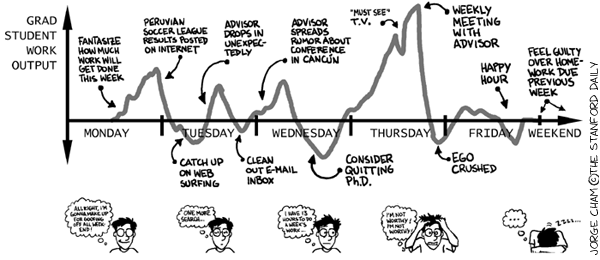
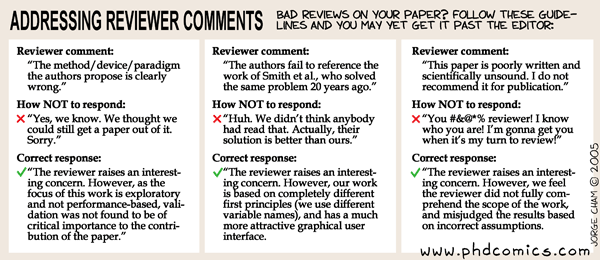
If you are or were even remotely associated with academia in the past few years, say you were a graduate student doing your PhD or thinking of applying for a doctoral degree, it is very likely that you read Dr. Jorge Cham’s excellent comic strip – Piled Higher and Deeper (PhD). Dr. Cham came to Vancouver to give three talks, hosted by the Faculty of Graduate Studies and the Child and Family Research Institute and co-sponsored by the Graduate Student Society and GrasPods, BCCRC.
(c) Dr. Jorge Cham. Used with Permission
I had an opportunity to attend one of the three lectures that Dr. Cham delivered (I know he is easy going and he doesn’t mind being called Jorge, but I have to admit that I have been feeling lately more inclined to make people call me Dr. Raul, just because hey, I *did* manage to complete my PhD!). And on this topic I had a chance to talk briefly with Jorge one-on-one and mention that reading Piled Higher and Deeper contributed to my sanity during the course of my PhD.
(c) Dr. Jorge Cham. Used with permission
Don’t get me wrong. My supervisor and my doctoral committee were absolutely supportive and really insightful, helped me a lot along the way, and were instrumental in me being able to obtain the degree. However, reading PhDComics always brought a smile to my face and allowed me to think about academia in a much lighter and less worrisome way. Jorge shared some worrisome statistics on the pressure that graduate students feel (only to, you know, making about the same amount of money that someone working at McDonald’s would make! — Jorge presented data to support this claim).
I didn’t do a PhD for the money, that is definitely for sure. I did it because it was gratifying to study phenomena and trying to understand the world. I love research, and that’s one of the reasons why I started a separate research blog – to communicate my findings and my experiences studying the phenomena I choose to research and be able to reach to a broader audience. Of course, I also love teaching and doing consulting work. But I am still interested in answering questions, in thinking hard, in analyzing and examining phenomena, in trying to create new methods and theories and applying innovative empirical research methods.
In short, it was a pleasure to talk to Jorge in person, I really enjoyed his talk and I definitely will stay in touch. I’m just kind of slightly surprised he is NOT on Twitter. But I might just convince him to change that 🙂 And if you’re in academia (or even remotely thinking of doing a PhD), read PhDComics. Trust me, it will definitely do good to you!
I almost can’t believe it’s been 18 years since I held my niece E in my arms as a little baby. Eighteen years ago, I took a bus back to my parents’ hometown because I had this nagging feeling that my sister-in-law was about to give birth. My intuition didn’t betray me (it rarely has) because a few hours later, I was at the hospital, accompanying my brother and his wife in this momentous occasion. She was our family’s very first niece!
While we were a family of five boys (yes, I have FOUR brothers) we suddenly had to become used to actually having a girl in the family. Quite obviously, being the first, she has had to both endure a lot of challenges and been lucky to be spoiled rotten in some other areas. I am very proud of her and I know that she is currently under a lot of stress as she is trying to find financial aid to undertake her undergraduate degree in the US (by the way — do any of you dear readers know anything about scholarships for international students at the undergraduate level in the US? If so, could you please send me a message via my contact form or a tweet or an email, or drop a comment? Thanks!)
To my dearest princess: you make me proud every day and you continue to amaze me with your maturity in a number of realms. I know that you are working hard and that you realize that these are the times to work even harder. Remember that your sisters look up to you and that you set the example. Work hard. Play hard. Be happy, and laugh a lot. Find a moment every day to reflect and take stock of the blessings you have and don’t ever lose sight of the fact that your family (your Mom, your Dad, your sisters and of course all of us your extended family) love you very, very much and that we will be there to support you along the way. You will succeed, sweetie. I have plenty of confidence in that.
Today and every day, sweetie I wish you happiness, health, success, but more than anything, lots of love. Love you always, your uncle R.
I was invited as a media representative to attend a breakfast and interactive session with Dr. Peter Senge, author of The Fifth Discipline and the founding director of the Society for Organizational Learning (SOL), as well as a Visiting Lecturer with the Massachussets Institute of Technology (ironically, my first choice for when I was deciding where to go and do my PhD). More coincidentally, the training that Dr. Senge and I have is fairly parallel (undergraduate in engineering, masters and PhD in social sciences/interdisciplinary/management). And not surprisingly, we are both interested in learning organizations.
I plan to to a more detailed analysis of the talk on my research blog. You can read my live notes on this post. Overall, it was a very good event. As I had mentioned to Terry Hadley (Director of Communications for the Vancouver Board of Trade), for people who haven’t been exposed to the notion of a learning organization, it was a great talk. Peter is a very good speaker. One thing I have to admire and appreciate is that he stayed pretty academic throughout. Often times, I’ve seen scholars move to the “I’m a great thinker” camp and forget about their academic roots and training. Luckily, that wasn’t the case with Peter Senge.
The five disciplines that Senge promotes are:
Systems thinking
Personal mastery
Mental models
Building shared vision
Team learning
You can read more on Senge’s work here – Smith, M. K. (2001) ‘Peter Senge and the learning organization’, the encyclopedia of informal education. [www.infed.org/thinkers/senge.htm. Last update: February 05, 2009]
What follows below are my live notes from the talk. Thanks to the Vancouver Board of Trade for inviting me as media. I had a very pleasant talk with Terry about the role of new media (bloggers) in covering events. We also discussed having wireless access for the upcoming events (particularly, I think I’ll be focusing on the March 6th event on Green Energy)
So when you read my notes, think about them as a liveblog as I captured his thoughts on the spot. I have made very few editorial changes.
Action towards climate change is important . Roughly 90% of BC Hydro’s staff are involved in conservation practices outside of work.
THE NECESSARY REVOLUTION
Dr. Peter Senge
Senior Lecturer, MIT; Founding Chair, SOL; Author
Dr. Senge doesn’t come to Vancouver very often (although he comes to Seattle relatively frequently). The first part of the talk is a presentation on the kind of work he does. Dr Senge is an engineer by training (coincidentally, so am I!) so he believes in tools. All learning is doing. So he’s going to undertake a practice-oriented session (a workshop)
Dr. Senge’s work in the last 10 years he’s worked on the Society of Organizational Learning’s objectives. How do organizations learn from one another.
Core Learning Capabilities
– Aspiration (personal mastery, shared vision)
– Reflective conversation (mental models, team learning)
– Understanding complexity (systems thinking)
Evolution from focusing on individual organizations to realizing that we were building a network of organizations. The reason why they founded the research centres was to build new capabilities, to see the larger system, to work across boundaries. Pretty quickly, if it’s going well, trade may foster collaboration and people start doing things together.
The Global Sustainable Food Lab is a collaboration between numerous companies, non-profit organizations, academics. This lab focuses on the global food system and its sustainability. Apparently, the average pound of food in America travels 2,000 miles (the data change frequently).
Senge shows a graph on the prices of the 6 largest traded agricultural commodities in the world (soybean, corn, wheat, cotton, edible dry beans, potatoes). All of these commodity prices have gone down. Food prices (particularly corn price) started rising again around 2005, a big issue, huge problem because of ethanol (the big speculation on bio-fuels, particularly corn, being taken out of food production and into ethanol).
Food is our first system, the thing we actually consume. It’s still the world’s largest industry. Agriculture is still the largest employer of people. The question of what do you make of the significant trends on corn prices, and issues with bio-fuel is not an easy one. From the perspective of consumers. This is an example of ‘the success of globalization’ – we make more and more food available to people at a lower, lower pricer.
The rich Northeners benefit the most of this globalized system because they can consume apples whenever they want (even out of season). Not many people complain about this for the rich. It is a disaster for the farmers of the world, because these prices aren’t enough for their survival. Roughly 50 million people on average migrate from rural to urban environments in the developing world. Why would anybody choose to live in such a setting unless they had no choice? Arguably, the world’s food system is the greatest cause of poverty. And it is an illustration, it’s food for thought.
No one is seeking to bring this about. From a business economics standpoint most of us don’t recognize these . Commodity markets are characterized by falling commodity prices. In a pure commodity market, profits always go back to zero (basic economic theory). This doesn’t into account social or ecological concerns.
The vicious cycles that get kicked in by these dynamics (increased use of pesticides, etc.) because their margins are falling and profits are low, so they are trying to grow more. That, of course has a negative environmental impact.
The Global Sustainable Food Lab was launched by Unilever and Oxfam. One of the most significant changes that in the last 5-10 years have arisen, the Oxfam campaigning has changed a lot (from family relief to poverty alleviation). Their purpose now (Oxfam) is the end of the structural causes of poverty. What would make Oxfam collaborate with Unilever? Unilever has been working with World Wildlife to establish the Marine Stewardship Council. Why is Unilever doing this? Pretty simple “our business is based on food, otherwise we fail).
Water is the most acute problem in our world today (Note from Raul – I’ve been saying this in my own research for the past 10 years!). The scary statistics by 2020 by WHO 3 billion people in the world will not have access to clean drinking water. There are no substitutes for water.
In our way of operating our society, the number 1 issue for any head of state is the economy. If there is a prolonged period of negative economic growth, we are in trouble. This is just a reflection of how we live. Factually, we probably pay the least attention to the environment.
But we have it backwards. The ‘wedding cake of our priorities’ should go as first ecology, second society, third economy (I’ll draw a diagram when I have a chance).
Peter is now referring to the work of Dana (Donella) Meadows – the continuum space and time. [Raul’s note – I actually love the work of Dana Meadows – she was the first person I had ever read whose work on systems thinking became influential and had an impact on my scholarly work]
People have asked Peter about what happens to CSR under tough economic conditions. People can say whatever they want When times get tough, people pay attention to what they consider more strategic.
Peter’s training at MIT was under Manning J. Forrester (complex systems thinking). They’ve been doing work on systems thinking. You have to pay attention to time horizons. They started doing a lot of work on shared vision and visioning tools. Rationality is a weak tool to compel people to have a long-range planning horizon.
Why do we think in decades vis-a-vis our kids? We do it naturally because we care. So we started realizing that systems thinking and shared visions of the future are one and the same and should be integrated. We can build better mental models if we focus on a long term, shared vision.
What was the mortality rate of firms in 1982 (3-4 decades average). This is the case during the last industrial era. Very large successful businesses. Half the expected lifetime of individuals in those same societies.
A study found that 20 companies that were 200 years old or older. About half of them were European, 2 in the US (Procter and Gamble and Dupont) and a few in Japan. The vast majority of very successful businesses actually don’t live very long and then you have a bi-modal distribution. Obviously they have an ability to learn and adapt and survive for quite a long time.
Features of long lived companies
* Identity: sense of who we are that transcends what we do. The eternal question – who are we?
* Tolerance: Openness to what we do not know. We tend to be arrogant and think that we know EVERYTHING.
* Fiscal conservatism: Maintain control of one’s destiny. The companies that don’t get into dangerous financial practices.
* Sensitivity to environment: Larger sense of responsibility, as a natural by-product of how we operate. This is interesting considering that the study was around 1982 and published in 1997 (when attention to the environment wasn’t amazingly strong).
Shell study in 1982 finally published in 1997.
A.P. de Geus, The Living Company, 1997.
A word or two about the book – the product of the last 10 years. The heart of the book are wonderful stories. These are stories not only of people who are radical environmentalists. Most of the stories are of people in responsible positions in organizations and non-profits.
In the last 5-8 years we have witnessed a big shift towards what collaboration between businesses and non-governmental organizations. The fair trade movement got a bit boost from Oxfam’s work (1999 – Great Rules and Double Standards). This report told a story of the trading regimes and the WTO.
We don’t know how to use our purchasing power to showcase our values. The fair trade movement allows us to do that and connects both concepts.
Peter is now talking about water access in India and the role of Coca Cola. Turns otu that there was an Indian blogger in Indiana who was filling up his blog space with incorrect facts. Until they figured out that they missed the biggest picture. Water is a very regional issue in India. Coca Cola was using very little of the water (mostly is in the deep aquifers).
It wasn’t about them to be right or wrong. The point was that they sell water in a country where there isn’t much water. They were wrong in some stuff that they had written before. They had a big campaign to improve water efficiency in their plants.
A lot of businesses start with efficiency measures.
He closes now with the conversation between WWF and Coke – “we appreciate your efficiency measures – our estimates is – you use on average 260 litres of water to make 1 litre of coke – because you never paid attention to the water necessary in the raw sugar that you are using in the process. He understood water and he said – we gotta do something – he went to the chairman of Nestle (given that they are both competitors, it’s amazing that they collaborated). We have a problem because water is a really big issue. In 2007 they announced jointly (Coke, Nestle) made a big announcement in Geneva – they both said – we decided that we have to work together – the world doesn’t know how to manage the water – it is the most acute problem – it has been exacerbated by climate change – wasteful practices and an affluent society.
– There was a question on what sustainability is – just stop using the word (it’s a buzzword). We should just get down to the real issues and the real aspirations. The thing is it has legitimated a lot of issues that otherwise would have been not talked about. For the very first time, a lot of the social justice activists and environmental activists are trying to work together.
We need to think in a systemic way – things aren’t disconnected, we need to look at systems from a holistic viewpoint.
Institutions really matter – of course we as individuals matter, but the question is always – how organizations interface
All real change is grounded in new thinking – this is the whole thing of mental models – we do what makes sense to us. We do what we do because that’s what kind of makes sense to us. Until we change our thinking, nothing really changes.
This post is sticky, which means that it will be promoted to the top of my blog for today.
I know I have a gazillion posts that I should have published but I’ve been swamped in work for the project we are about to unveil, and I didn’t have the time to think this properly. But upon further consideration, I think it’s a good idea to try a new restaurant in an area that a lot of downtowners would not normally go to. Decided on the new location of The Reef on Commercial Drive. I had previously reviewed The Reef on Main (my neighbourhood) and I predict it will be good times. Say 6.30pm to allow those of you who actually need to stop by your homes before heading out for dinner.
What: Dining Out for Life Tweetup with Raul (aka Hummingbird604) When: 6:30pm, The Reef on the Drive (see location map below) Why: Hang out, socialize and contribute to a worthy cause (Dining Out for Life 2009) Who: You, me, everyone is invited.
In 2007 I Blogathoned for A Loving Spoonful, a local charity focused on delivering warm and nutritious meals to people afflicted with HIV/AIDS. As many of you know, I am a big supporter of A Loving Spoonful and all causes associated with prevention/treatment and essential services for those who are affected by the deadly disease.
On Thursday March 12th, 2009, hundreds of local and BC restaurants will be participating in Dining Out for Life. Twenty five percent (25%) of all meal costs will be donated to A Loving Spoonful in order to help them continue with their awesome work.
I’ve Dined Out for Life other years, and I will be organizing a Dining Out for Life Tweetup on the same day, and I am also aware that my friend Karen Hamilton is an Ambassador for DOFL at Tomato. Karen’s blog post on Dining Out for Life is linked here, go check it out. She also mentioned Eagranie and her commitment to the cause (I knew that Eagranie of The Well Tempered Chocolatier was a foodie, but didn’t know she did stuff like this for DOFL. Awesome!
If you are interested in joining me (or are a participating restaurant) drop me a line on my contact form or leave a comment on this post. Please consider participating in Dining Out for Life. It’s for a good cause. Thank you!
Lorraine is organizing a fundraiser for the Federation of BC Writers on March 16th, 2009 from 6 to 9pm at The Vancouver Police Museum, and she asked me to spread the word (which I’m very happy to do) so I’m going to simply cut and paste from the Eventbrite link (where you’ll find the details to register to attend) and let you read the gory details. As an aside, I’ve offered to auction a date with me (with dinner included), so feel free to bid (and if you are a restaurant willing to sponsor dinner, all the better!)
Wanted: YOU!
Come help the Fed celebrate 32 years of getting away with murder. Whether infiltrating schools, divvying up swag, or distributing subversive publications, the Federation of BC Writers has been operating unchecked in our province for decades.
Do you enjoy the vicarious thrill of rubbing shoulder pads with the Lost Literati of the Wild West? Do you have what it takes to make your bones as a Fed member? There’s only one way to find out! Come out to the party and make us an offer we can’t refuse.
Admission: $20 minimum donation includes a drink and appetizers.
Dress code: Trenchcoat and fedora, deerstalker and cape, jailhouse stripes, uniforms, Bond Villain suits or femme fatale slinkwear all optional but encouraged. Attitude absolutely mandatory.
Raffle prize donations, bribes, and sponsorship applications very welcome: please email lorraine.murphy at Gmail dot com. Anything related to crime or the theme of noir is particularly welcome, eg detective books, Martini glasses, etc, or anything black or white.
If you’d like to perform a reading of some of your dark material, please contact me as well and we can make arrangements.
The Crime Pays fundraiser will be our Shebeen Club meeting for the month of March, so I hope to see everyone there, dressed fabulously and behaving infamously!
Last year, I noticed that Corinna had written a substantial post on Earth Hour Canada (to which I linked in a linklove post earlier in 2008). She’s been promoting the very worthy work of WWF for a couple of years now, which I think is awesome. This year, Corinna has written again about the issue and how she and Adam try to be green year-round. In January of this year, the World Wildlife Federation (organizers of Earth Canada Hour) contacted me to help spread the word on Earth Hour Canada (hat tips to Dave Jones for linking them up with me) and I was very happy to do so. Several of us will be spreading the word soon so I’ll be sure to link back when I know about their posts.
On March 28th, 2009, from 8:30pm to 9:30pm, millions of Canadians will turn off their lights for Earth Hour in support of action on climate change. You can encourage friends and family on the WWF-Earth Hour Canada site. The WWF is also encouraging participants to think about ways to reduce your carbon footprint (e.g. transit, unplugging electrical appliances, etc.)
Well, it’s definitely happening. Thanks to Isabella, we now have a dedicated website for all things Mental Health Camp (I’ll be managing the website) and I’ve created the EventBrite site for the registration. Please spread the word, and register early as we estimate it will be sold out! As indicated, attendance is by donation (collected at the door), but nobody will be turned away for lack of funds.
Thanks also to Cathy Browne for her hard work and excellent copywriting skills which helped create the press release – we will have it ready early next week. So, mark your calendars, April 25th, 2009 (9am – 6pm, WorkSpace), Mental Health Camp is happening!. Thanks to sponsors, organizers, volunteers!
It’s no secret that I’m a fan of female superheroes. I loved the movie Daredevil and its sequel Elektra, and I’ve written about my idea of blogging as a superpower on my blog before. I have also written about how much I admire my mother, who is a superheroine in and of herself. Coincidentally, I wrote about her on IWD 2008
Let me start with the most important woman in my life, my Mom. My mother is highly educated, undertook her PhD in political science when she already had grown kids, has lived abroad, maintains a leadership position in her school and has many amazing qualities. The thing is, to me, that has always been completely normal. We (my brothers and I) were raised in such a way that gender really didn’t matter. All that mattered was that she was(and is) amazing, period.
To Mom, my sisters in law, my nieces, my friends and all the women in the world, I say – Happy International Women’s Day!
It’s no secret that I love North Vancouver, and there are good reasons for such adoration. A number of my close friends live in the North Shore, and I always love to come and visit and hang out when I need to clear my head. Downtown is always brimming with people, and frequently I feel as though I’m somehow in New York. Given that my office is downtown, at The Network Hub, I am pretty much surrounded by people ALL the time. Sometimes, even East Vancouver feels too overwhelming (I know, this sounds completely NOT like me, but at times, even though I love people, I also need to disconnect completely).
There is a unique charm to the North Shore. The combination of increasingly densified urban development with the charm of older single-family dwellings, the eclectic mixture of restaurants, small businesses and residential units makes North Vancouver an exciting municipality, in my humble opinion.
I recognize that I have only explored bits and pieces of the North Shore. I’m a frequent visitor to Deep Cove and the community of Panorama. Hiking towards Indian Arm is a highlight in my book of adventures. Having brunch at Arms Reach Bistro accompanied by a sweet mango martini is also fantastic.
Lynn Valley and Lynn Canyon have also provided me with a number of opportunities for adventure and bonding with my close friend JT. The suspended bridge in Lynn Canyon is always a pleasure to walk through.
Hanging out in Lower Lonsdale is also very good for my soul. There’s always Lonsdale Quay and the Quay Market where I can go and buy some fresh fruit and sit by the pier and watch the beautiful view of downtown Vancouver.
I will be in North Vancouver for most of this week, as luckily I have only one evening event (Wednesday evening, even though I’m quadruple-booked, I’m going to just attend two of the events. And I have a full day of day-meetings on Monday, but the rest of the week, looks like I’ll be a North-Vancouverite.
I would be happy to organize a lunch-time or coffee Tweetup for those of you who are based out of North and West Vancouver.
Rachel Black, PhD
University of Gastronomic Sciences
University of British Columbia
Abstract of the seminar
Is it possible to develop a concept of ‘Slow Wine’? The first task will be to create a working definition of ‘Slow Wine’ starting with the basic principles of the Slow Food philosophy. This paper then look at the theoretical issues associated with a ’slow’ philosophy applied to the wine industry, with specific reference to Italy. In particular, the way in which perceptions of nature, technology and quality intersect and influence production and consumption will be explored here. Case studies from the Italian and international wine industry will be used to look at new models for and challenges to a ’slow’ and sustainable approach to wine.
Have you all heard about “Slow Food”? It’s a movement (started early in the 1980s) over 80,000 members. It is a non-profit, largely volunteer organization and defines its mission through: – Defense of biodiversity – Taste education – Connecting with producers and co-producers
The snail as a symbol oof slow resilience is the movement’s logo. Interestingly, slow food finds its roots in wine (Carlo petrini – he founded Slow Food in 1989 and remains a central figure of the movement).
4:09
A few producers tried to create stronger wines by adding methanol in Italy a number of years ago. This reminds people about what has happened in the Italian wine industry and whatever credibility it had.
4:10
Support the movement towards quality and reduce the emphasis on mass production.
4:11
Rachel met with engineers working in water issues, wine producers, etc. This is the wine producing area (Piedmont) – where the scandal happened is related to this area. Slow food started in the town of Bra. It really started in the heart of wine country.
4:13
Slow food fighting against the encroachment of fast food. A guide to eating well in Italy. The restaurants participants must meet certain standards. Enogastronomic guide books help shape the Slow Food movement.
4:15
“Take the time to enjoy food and share with friends and family”. Why Slow Food hasn’t translated into Slow Wine. “Eating as an agricultural act” – Now Rachel describes the movement of Vinaroon and biodynamic wines.
Rachel and Anthony have pondered – Why slow foods don’t translate or adopt into the wine thing?
4:16
http://www.farmsteadwines.com – “Farmstead Wines connects you to artisan farmers who make rare, handcrafted wines of sustainable provenance. Now, drinking fine wine is an agricultural act too.”
4:19
Like many other wine guides, the Italian Wines guide places emphasis on the wine quality and offers ratings.
4:20
The Wine Guide does not judge the wines based on the production method. It doesn’t give any consideration for respect for tradition or sustainability. The value judgement is based on the sensory perception and tasting. So, what does make it slow?
4:22
Why is something similar to Slow Food not possible for the Wine Guide?
Can you think of any other product that is described in such abstract terms? Possibly artisan beer, and ethical coffee but we don’t talk much about ethical wines.
4:24
Tasting notes – “The Wine Spectator” “88 [Points] Chateau – Cantemerle – Haut – Medoc 2006 $ 31 – Blackberry and sweet tobacco follow through to a medium body, with slightly aggressive tannins and a medium finish. Chewy. Needs time to mellow. Best after 2011. 33,330 cases made – J.S.” – Wine Spectator, March 31st, 2009.
What did we learn from the Tasting Note?
We are given a judgement about when the wine should be drank but nothing about how the wine was made and the implications of its production method.
4:26
After analyzing the discourse of a sample of Wine Guides and blogs, the comments disassociate the wine with its production methods. This method is different from talking about food (we talk now more about the ingredients and the origin of the ingredients – and these elements form a judgement of quality).
What are the perceptions of quality?
Preparation and provenance of ingredients are value judgements of how food is judged now.
4:27
Why isn’t that happening with wine?
Rachel’s fieldwork in Italy was very much with wine makers. When she came to North America she started talking to people who know from very little to a lto about wine (and who enjoy the wine). They rarely mention ingredients or production methods (in her interviews, that’s what she found).
4:28
Very little knowledge of the technical details was found in her interviews. Her informants said that they didn’t have the technical knowledge about wine when it comes to describing the wine and the production methods.
4:29
Do you ever think about the production methods of wine when consuming it? Sometimes
( 0% )
No, why would I?
( 0% )
Yes, of course!
( 100% )
4:30
Wine hasn’t reached that point where methods of production are relevant. In France location and provenance is key in wine (Charles Menzies’ comment)
4:30
Knowledge is extremely local.
4:32
Is this the case with other beverages? Do people have much knowledge about the process and production method?
There is a whole field of journalism that is specific to wine. Vodka and beer are just recently more now. The slow food approach would say ‘we need to really learn what is taste, what is quality’.
At University of Gastronomic Sciences – there are courses that are on beer making, etc.
Question – I’m wondering about scale – If you go to a wine tasting in Sonoma or Napa you will definitely hear about the production techniques.
4:34
British Columbians are now gaining an interest in wine.
4:35
Raul Pacheco-Vega (me) made a point about environmental policy and the design of environmental policy instruments that are based on information dissemination (regulatory schemes – eco-labels) – eco-certification schemes.
In her interviews, expert opinion plays a part in perceptions of quality, that are mainly subjective and associated with taste.
These are initial interviews.
4:37
Rachel is noticing another trend – the language that wine consumers are using is “healthy and tasty”. Some individuals expressed guilt about their wine consumption but they justify consumption by saying ‘it’s natural, and healthy’. They felt that, compared to other forms of alcohol – less fattening, helps digestion, goes well with food, etc.
What Rachel started to see is that wine consumers go through the ‘natural process of fermentation’.
4:38
Rachel’s further research – perceptions of nature, technology, the use of technology in wine making. Fermentation isn’t quite as natural as some people think. Dr. Van Buren developed genetically modified yeasts so that the wine wouldn’t give as much headache.
4:41
Viticulture and agriculture as natural processes?
There is a human-plant relationship that has to do with the development of technique and knowledge on how to tend the grapevine. This is frequently left out of any kind of discussion. Now there’s a large movement towards organic wine production.
4:43
This idea of nature – there are so different perspectives – in the Lange there is no biodiversity, there’s just a monoculture – yet so many people think that it is so pretty, so natural, so pristine.
There are places where you should and where you should NOT grow grapes.
4:46
There are concerns about carbon footprint – the wine industry needs to address it and think about it. There is a mis-conception about what viticulture is.
Then we move into the cantina – the winemaking facility. Fermentation is a natural process. A grape grows and it wants to ferment. The berries are covered in natural yeast. But if you only get grapes ferment on their own you’ll get nasty wine.
4:49
Taste education connecting people to producers and place (Barbaresco – Martinenga)
The concept of GreenWashing – producers want to play on the idea of green marketing. There is also a great need for taste education.
4:51
Seminar’s over – now on to questions – I might continue liveblogging or just focus on the talk.
This morning, I had brunch with C, B and L. My usual brunch crowd. These are friends I met while we all were doing our PhDs at UBC (in different disciplines, but we all lived in the same residential college). I call these friends civilians as well, because even though they use computer tools for their day-to-day lives, they don’t blog or use much of any other social media platform (other than, well, Facebook).
My first impression of The Edge Cafe hasn’t changed. It is spacious, comfortable, pretty cool. The food we had was pretty good, actually in regards to my order, it was spectacularly good. I ordered a Yukon breakfast ($ 12.00) which came with a double side of ham (pretty good, filling, the quality and taste were very good too). The coffee is from 49th Parallel which is also a very tasty brand of coffee (and it’s bottomless, so you get frequent refills).
For the price, it’s good value for your money. However, I’d have to say that as far as brunch goes, the Edge Cafe is on the higher-ish end of the scale. I’ve had brunch at Crave and it’s less expensive (and of course, the greasy spoon places are even LESS expensive). But as I mentioned, the food was great and I can’t complain. The place filled up rather quickly after we arrived, but the service was prompt, friendly and the staff were very attentive.
The guide is an absolutely enjoyable read. But as I told Ianiv and Arieanna, I wish that this book had (a) been written one or two years ago, and (b) I had read it then. I’m going to start with a disclaimer. I’m not a newbie blogger anymore. Admittedly yes, it has taken me a while to get to where I am (I’d say that a solid year – my blog really took off during 2008, I would say). But I no longer need the basic suggestions. At this point in the game, I feel confident enough to help newbie bloggers and/or total strangers to blogging launch their sites. Heck, I do a LOT of my own techie stuff (of course, I am always appreciative of my friends’ help when it comes to CSS editing and issues of website management and maintenance).
I have learned a lot of the stuff that the editors of HuffPost suggest just by virtue of learning by doing, listening to other amazing bloggers speak about what they do and absorbing their best tips. I’ve learned from some of the best social media people in Vancouver, many of them recognized beyond the frontiers of the maple leaf country. So, really – for me, a vast majority of this book’s content was pretty much, a repeat of what I already knew. [UPDATE – At VIFF ’09 Bridget mentioned this book and I fully endorse that this book is worth acquiring and reading]
But fear not. Whether you are someone who is just starting to blog or a total blogstar, this book is for you. I couldn’t stop reading it today. I speed-read, as most of you know. Well, I had to stop myself, and read passages again and again so that I could savour again the page I had just read. It was like sipping a good glass of wine. The editors of the HuffPost have done us all a great service by virtue of compiling, distilling and publishing some of the best blog tips out there. Particularly relevant – the whole discussion on the future of traditional (mainstream) media vis-a-vis the rise of new media. I’ve written about the topic here, here, here and here. I’ve also liveblogged other speakers who have discussed the topic (here and here and here)
Would I love to have the HuffPost’s traffic? Maybe, maybe not. But one thing is for sure. I am sure as hell happy to have a copy of the Huffington Post’s Complete Guide to Blogging.
Disclosure – This review wasn’t paid. Nothing I have expressed has been influenced in any way, shape or form by external entities
We are very blessed in Vancouver. And I particularly feel very, very privileged. The support of launching pads as supportive structures for entrepreneurial activity in the information technology sector has made Vancouver a hub for creative work in tech. For example, in my case, I have always felt very fortunate to count with the support of The Network Hub (where I’m currently hosted), and I knew I could always count on WorkSpace if I ever needed them.
It is a known fact that WorkSpace has been a phenomenal supporter of events organized by the Vancouver tech community has always been superb. From events like Net Tuesday to BarCamp to a number of other events, WorkSpace has always been super-mega-ultra-awesome with us. So I felt pretty confident that they’d be willing to help and sponsor the space for Mental Health Camp (link takes you to the wiki page)
I recently spoke with Dane about what we were trying to accomplish with Mental Health Camp. He very quickly agreed to support us and for that, I am extremely grateful. I can’t thank WorkSpace enough. If you haven’t checked out WorkSpace and you are an entrepreneur based out of Vancouver, I would strongly recommend you to swing by.
WorkSpace is a shared work environment in downtown Vancouver. Our Gastown loft has meeting rooms, a lounge & a café surrounding a beautiful open concept work environment. We provide memberships (not leases) to independent professionals and small firms looking for a better place to work. WorkSpace
Thanks so much for helping with a worthy cause such as Mental Health Camp. Very much appreciated! So now, we have a date and we have a place – Saturday April 25th, 2009 – WorkSpace.
Last week, Kevin Grandia and Evan Leeson invited me along with a few other bright minds from various walks of life, all of them with an interest in the future of the web to an intimate, in-camera roundtable discussion on what we could expect in the next few years as the Internet evolves, technology advances and we become increasingly connected in a multitude of ways.
The participants of the first Gastown Dialogue on The Future of the Web were:
Evan Leeson (whose amazing new Gastown digs were the venue) President of Catalyst Internet
Trevor Junck, Junxion Strategies
Jacqueline Voci, Soya Marketing
Mitchell Anderson, science writer and the proud owner of www.freakyweather.com
Julie Morgan, longtime blogger and socialite
Raul Pacheco-Vega, researcher: http://www.raulpacheco.org/ and super-blogger
And Kevin Grandia, managing editor DeSmogBlog and New Media Director for Hoggan and Associates
Credit: Rob Cottingham
What are the Gastown Dialogues on the Future of the Web? Here, let me give you some information from Kevin Grandia’s email to all of us. I’ve edited some bits and pieces but you get the gist.
The Gastown Dialogues will be a once-a-month small (8 people max.) intense (2 hours, 2 topics) roundtable discussion (with wine and beer) with a mix of new media users and practitioners from professionals to casual users and people just starting out. The idea is not to have a 2 hour “hey look at how smart and cool I am” rap session. Instead this is an opportunity to share knowledge, create new ideas and network with like-minded people.
The roundtable will be recorded (bring your camera if you want, we have 2, but the more the merrier) and we will create a vidcast on a Gastown Dialogue YouTube channel, thus making it available for everyone to share and spur further conversation and ideas within their own networks.
While I do expect a fuller post to emerge from Kevin and Evan, I will share one of the interesting questions we discussed:
Topic 1: We’ve all heard by now and started to see what will be “Hot in 2009” in new media, so that’s said and done. But what will be “Hot in 2010” in new media? Will the semantic web finally come of age, will Facebook still be the behemoth, will blogging the written word be killed by video? What about mobile tech?